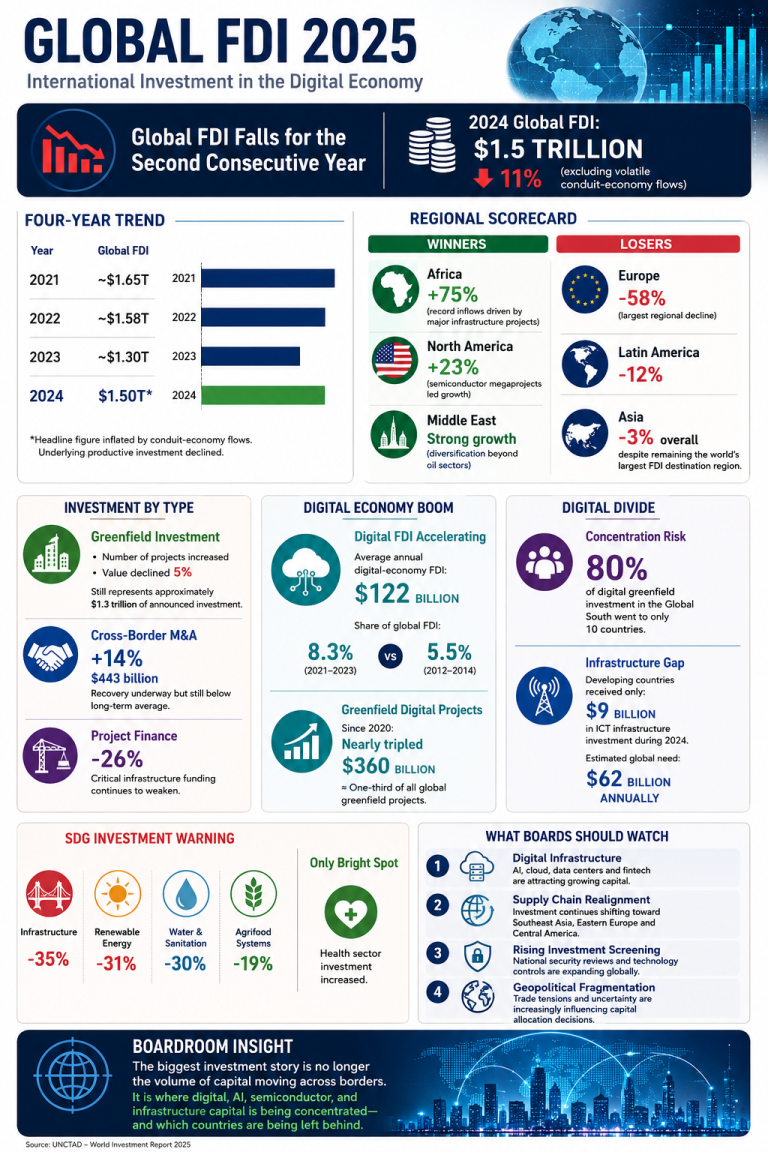

Why GDP statistics, revenue growth, financial performance or market share data can be lagging indicators and not the leading one? These data reflect realized economic activity, but not capital commitment decisions that precede them by 3–10 years.Boards spend considerable time reviewing these data which is important measures of performance, but there is a growing risk in relying on them too heavily when assessing the future.
Increasingly, some of the most important clues about future competitive advantage can be found elsewhere—in capital flows. Across the world, billions of dollars are being invested in AI infrastructure, semiconductor fabrication plants, battery manufacturing facilities, renewable energy projects, critical minerals, and advanced manufacturing hubs. These investments are shaping industrial ecosystems today and their effects become visible in GDP statistics, corporate earnings, or market share data later.
For example when a region attracts a major semiconductor fabrication facility,It attracts suppliers, engineers, research institutions, logistics providers, infrastructure investment, and skilled talent etc. Over time, these clusters evolve into centres of innovation, productivity, and influence.
However, boards should not view capital flows merely as indicators of future opportunity. They are also indicators of changing risk. Capital tends to move toward regions, industries, and technologies that investors believe will create future value. Equally important, it often moves away from areas perceived as vulnerable to technological disruption, geopolitical uncertainty, supply-chain concentration, or regulatory change. This makes capital allocation a valuable strategic signal.
Boards should therefore ask three key questions:
1. Where is capital flowing—and which ecosystems are forming as a result?
2. How are these shifts reshaping global trade corridors and competitive positioning?
3. What strategic exposure and forward-looking risks are being signalled by capital allocation patterns?