
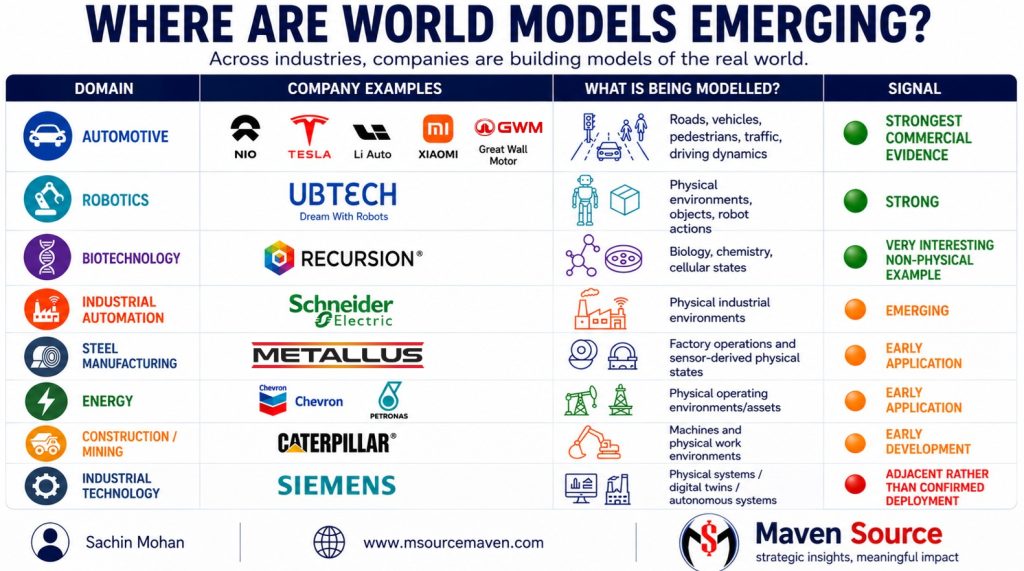
LLM is impressive. But something interesting is beginning to happen beyond LLMs. AI is increasingly moving towards world models—models that attempt to understand not just information, but the behaviour of the environment in which that information exists- i.e. the real world. Some companies already started discussing world models. Some are in the early development phase. Others are experimenting with early applications, while a few are moving closer to commercial deployment.
The strongest evidence today appears to be in the automotive sector. NIO, Xiaomi (in its EV business), Great Wall Motor and Li Auto have discussed world-model applications in their 2025 annual reports, particularly in intelligent driving. But the signal is not limited to automobiles. Early evidence and experimentation are also appearing across biotechnology, steel manufacturing, energy, construction, industrial automation and robotics. The technology is still at a very early stage and it is te right time to monitor developments and business applications.
Why this matters?
If you think deeply about what an LLM does, it is still giving us largely a 1D or 2D view of an event. Why? Because it does not inherently understand the physical and spatial dimensions of the real world in the way a world model attempts to do. Imagine you are working in a room on your laptop. Now imagine that every possible aspect of that room is being captured as data—the temperature, humidity, wind speed, sound, light intensity, water flow, movement of objects and many other variables. A model that understands these relationships could potentially simulate what might happen if you suddenly open a tap at full force: How much water could splash? Where would it go? What could it damage? What happens if the temperature falls by two degrees? What happens if the same conditions continue for several hours?
This is where world models become interesting. They attempt to model the behaviour of the real world and simulate what could happen when conditions or actions change. And this is different from Virtual Reality. VR gives you the experience of a simulated environment. A world model attempts to give an AI an understanding of how that environment behaves—and, more importantly, what could happen if something changes. That distinction could be extremely important for business. Several companies already thinking or in the stage of implementation of world model to create simulation to better manage the risk and forecast.
Strategic implications
I see at least four areas where this could eventually become strategically important.
Risk management- Companies may move from simply analysing historical risks to simulating how risks could unfold. An insurer, for example, could potentially model how a flood, fire or extreme weather event might propagate across physical assets and supply chains.
Forecasting- Instead of asking only, “What is likely to happen based on historical data?”, companies could increasingly ask, “What happens if we change this variable?” This moves forecasting closer to simulation.
Operations- Imagine a manufacturing company with a model of its machines, production lines, inventory, energy consumption, suppliers and quality data. Management could potentially test different operating conditions before making a real-world change.
Testing product in simulated environment- With spatial data and real world environment, the testing becomes more reliable and we can run scenarios in simulated environment.
The journey may start with something quite basic: capturing as much relevant real-world data as possible and understanding the relationships between those variables. That itself could become a competitive advantage. I think world model could become the next layer of AI—moving us from understanding information to understanding environments, and from analysing the past to simulating possible futures.
Questions every board should ask
I would not expect every company to start building a world model tomorrow. The technology is too early and, in many industries, the business case is still unclear. But boards should start asking some uncomfortable questions.
- What parts of our business are fundamentally physical?
Machines, factories, logistics, infrastructure, customer environments, energy consumption or supply chains? - What data are we currently capturing from those environments?And more importantly, what important data are we not capturing?
- Could we simulate the consequences of major decisions before implementing them?
- Are our competitors beginning to build this capability?
- Are we investing only in AI that analyses historical information, while others are beginning to build systems that simulate future scenarios?
- What would a “world model” of our business actually contain?I would not recommend that companies rush into buying a “world model”. The technology and terminology are still evolving. Instead, I would start with the foundations.
Actions leaders should consider next:
- Identify one physical business environment where simulation could create significant value—perhaps a factory, warehouse, energy asset, logistics network or major infrastructure project.
- Map the data. Understand what sensors, IoT systems, ERP, MES, CRM, operational systems and external datasets already capture—and where the gaps are.
- Experiment with a narrow use case. Don’t try to model the entire enterprise. Start with one decision where the consequences are expensive or difficult to reverse.
- Explore digital twins, simulation, reinforcement learning and world-model technologies together. The boundaries between these technologies are still developing, and companies should understand how they can complement each other.
- Build internal capability before the technology becomes mainstream. You may not need a world model today. But you may need the data architecture, sensors, simulation capability and talent that will allow you to build one tomorrow.
The technology is still in a very early development phase. That is precisely why I think it deserves attention. The biggest strategic mistake may not be adopting world models too early. It may be waiting until everyone else has already figured them out. If world models eventually become the bridge between AI and the physical economy, the companies that start building that bridge today may have an advantage that is difficult for latecomers to replicate.