
We are witnessing a strategic shift in global manufacturing. The era in which production was located wherever labour was cheapest, with a focus on optimizing logistics and maintaining minimal inventory, is coming to an end. Manufacturing is entering a new phase—one in which geopolitics is becoming as important as economics. Today, investment decisions are increasingly being influenced by questions that would have been uncommon in boardrooms just a few years ago. Questions that were once considered “off the mark” are rapidly becoming central to strategic decision-making.
The questions now echoing across boardrooms include:
- “Can we trust this supplier during a geopolitical crisis”?
- “Will export controls restrict access to critical technologies”?
- “Is our manufacturing footprint resilient enough to withstand regional conflicts”?
- “Will governments continue supporting investment in our industry”?
At first glance, these questions may suggest that we are moving toward deglobalization. But that is not the case. What we are witnessing is a reconfiguration of globalization.The traditional pillars of manufacturing—”efficiency”, “low cost”, and “unrestricted global integration”—are being replaced by “resilience”, “strategic capabilities”, and “trusted ecosystems”. This shift is already underway and is changing the direction of global capital flows. Investments and government priorities are increasingly concentrating on a few strategically important sectors, including semiconductors, advanced manufacturing, AI infrastructure, and critical minerals. Governments now view manufacturing capacity as an element of economic security rather than simply an engine of economic activity.
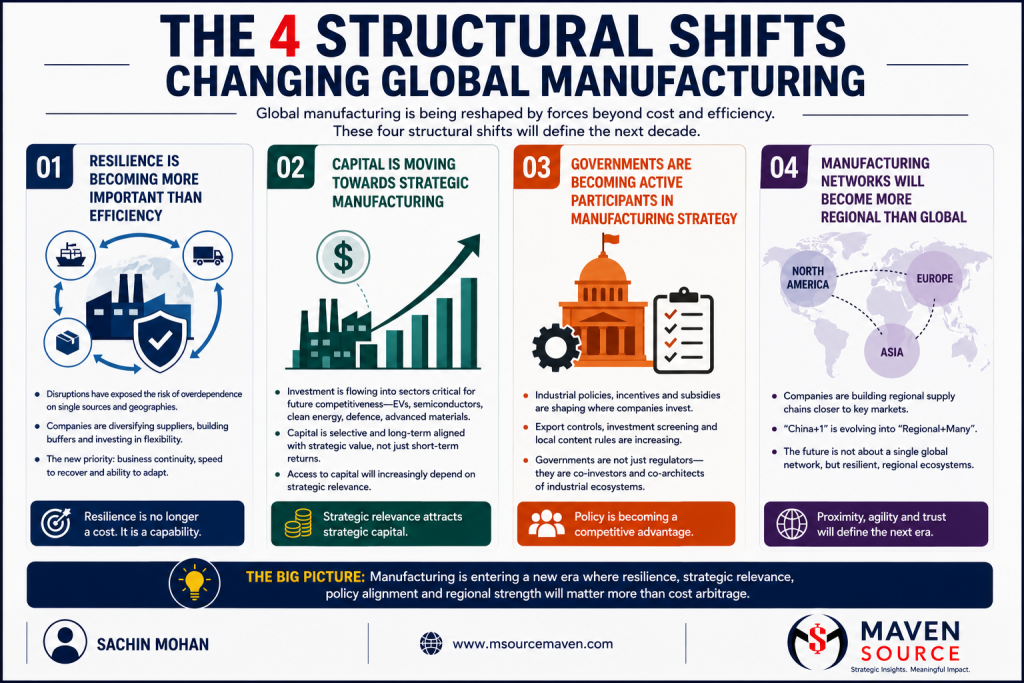
Strategic Shift 1: Resilience is becoming more important than efficiency
In a relatively stable world, manufacturing strategies were primarily driven by efficiency. Companies focused on reducing costs, minimizing inventories, and concentrating production in low-cost countries. Lean supply chains and just-in-time inventory systems were considered best practices because they improved profitability and reduced working capital.
However, a series of global disruptions—including the COVID-19 pandemic, the Russia–Ukraine war, and the conflict in the Middle East—exposed the vulnerabilities of highly concentrated supply chains. Many companies discovered that dependence on a single country, supplier or logistics route created significant concentration risk. A disruption in one location was often enough to halt production across multiple continents.
As a result, manufacturers are reconfiguring their supply chains with a greater emphasis on resilience rather than cost alone. Production is becoming more geographically diversified to reduce dependence on a single manufacturing hub. Companies are qualifying multiple suppliers for critical components, building regional manufacturing capabilities and increasing supply-chain flexibility. The strategic question has shifted from “How efficient is our supply chain?” to “How resilient is our supply chain?”
Apple provides one of the clearest examples of this shift. Until a few years ago, more than 90% of iPhones were assembled in China, making the country both Apple’s primary manufacturing base and supplier hub. Following the COVID-19 lockdowns, rising U.S.–China geopolitical tensions and repeated supply-chain disruptions, Apple began diversifying its manufacturing footprint. Today, the company has significantly expanded production in India and Vietnam while continuing to maintain a substantial presence in China. This “China + Many” strategy is not about abandoning China; it is about reducing concentration risk and building a more resilient global manufacturing network.
Strategic Shift 2: Capital is moving towards strategic manufacturing
I encourage manufacturing leaders to think beyond today’s financial performance. Profitability tells us how well the business is performing today, but investment flow trends often reveal where competitive advantage will exist tomorrow. The strategic question therefore becomes: Is our business positioned where future capital wants to go? Investment is becoming highly selective in nature. Governments, investors are concentrating their resources in some specific sectors that will define the future, I.e. AI infrastructure, Semiconductor, advanced manufacturing, critical minerals etc. The companies that operate within that strategic ecosystem will attract talent, investment, and will get better opportunity for technology partnerships. The firms outside of the strategic ecosystem will not vanish, but they will fight for diminishing investment. The firms that will survive in next decade will be the ones who repositioned themselves within emerging strategic industrial ecosystems.
Strategic Shift 3: Governments are becoming active participants in manufacturing strategy
Historically, selecting a location for a new manufacturing facility involved evaluating labour costs, infrastructure, taxation and market access. Today, another layer has become equally important.
Does this country want us to manufacture here? Governments across the world are investing unprecedented amounts to attract strategic industries. Tax incentives, subsidies, local-content requirements, investment screening, export controls and preferential procurement are no longer exceptions. Governments are no longer trying to attract every type of manufacturing. They are selectively encouraging industries they consider strategically important while imposing greater scrutiny on sectors linked to national security, advanced technologies and critical infrastructure.
This shift is already visible across major economies. The United States is investing billions of dollars through the CHIPS and Science Act to encourage domestic semiconductor manufacturing while restricting recipients from expanding advanced chip production in China. Similarly, the European Union’s Chips Act is using financial incentives to attract semiconductor investments and reduce dependence on external suppliers. At the same time, governments are tightening investment screening and export controls in sectors such as semiconductors, AI and critical infrastructure, making national security an increasingly important factor in manufacturing investment decisions.
Also, the U.S. Inflation Reduction Act (IRA) which give generous tax credits for electric vehicles, batteries and clean-energy manufacturing, prompting companies including Hyundai, LG Energy Solution, Panasonic and Ford to announce major investments in U.S. manufacturing facilities.
Strategic Shift 4: Manufacturing networks will become more regional than global
One of the biggest misconceptions I see today is that globalization is coming to an end. I don’t believe that is happening. What I believe is ending is the idea that every company should serve the world through a single, highly integrated global supply chain. For years, manufacturers concentrated production in one or two low-cost locations and supplied customers across multiple regions.
Today, I see companies adopting a different approach. Instead of relying on one manufacturing hub to serve the entire world, they are building regional manufacturing ecosystems. Production is being distributed across multiple geographies, with facilities located closer to key customer markets. For example, Tesla has built regional Gigafactories in North America, Europe and China, enabling it to serve major markets locally while reducing dependence on a single production base. Similarly, Schneider Electric has redesigned its manufacturing and sourcing network around a “multi-local for multi-local” strategy, producing closer to customers and diversifying suppliers to improve resilience. Both companies demonstrate that globalization is not disappearing—it is becoming more regional, flexible and resilient.
The key questions are can production be shifted quickly between facilities? How rapidly can alternative suppliers be activated if a critical supplier fails? Can products be customized to meet regional market requirements without disrupting operations? Most importantly, can the business continue serving customers when unexpected disruptions occur? These are the questions that I believe every manufacturing board should be asking today. In an increasingly uncertain world, resilience is no longer just an operational capability—it is becoming a source of competitive advantage.
What this means for boards and CEOs
Taken together, these structural shifts require manufacturing boards to rethink how they approach long-term strategy. Traditionally, board discussions around manufacturing focused on operational efficiency, capacity expansion and cost management. While these remain important, I believe they are no longer enough to prepare businesses for the environment that is emerging.
Manufacturing strategy has become far more interconnected with geopolitics, industrial policy, technology and supply-chain resilience. Investment decisions are no longer driven solely by commercial considerations. They are increasingly influenced by government incentives, trade policies, national security concerns and the need to build resilient manufacturing networks. As a result, boards can no longer assume that the conditions that supported manufacturing success over the past three decades will continue unchanged.
In my view, manufacturing strategy can no longer remain the responsibility of only the operations or supply-chain function. It deserves regular discussion at the board level because many of the most significant risks facing manufacturers today are strategic rather than operational. Questions around where to invest, how to diversify supply chains, which technologies to adopt and which capabilities to build will shape competitiveness for years to come.
The manufacturers that succeed over the next decade will not necessarily be those that react fastest to disruption. They will be those whose boards anticipate structural changes early, invest ahead of the curve and position the business before competitive advantage shifts. I believe that is where the real opportunity lies—not in responding to change, but in preparing for it before it becomes obvious.