
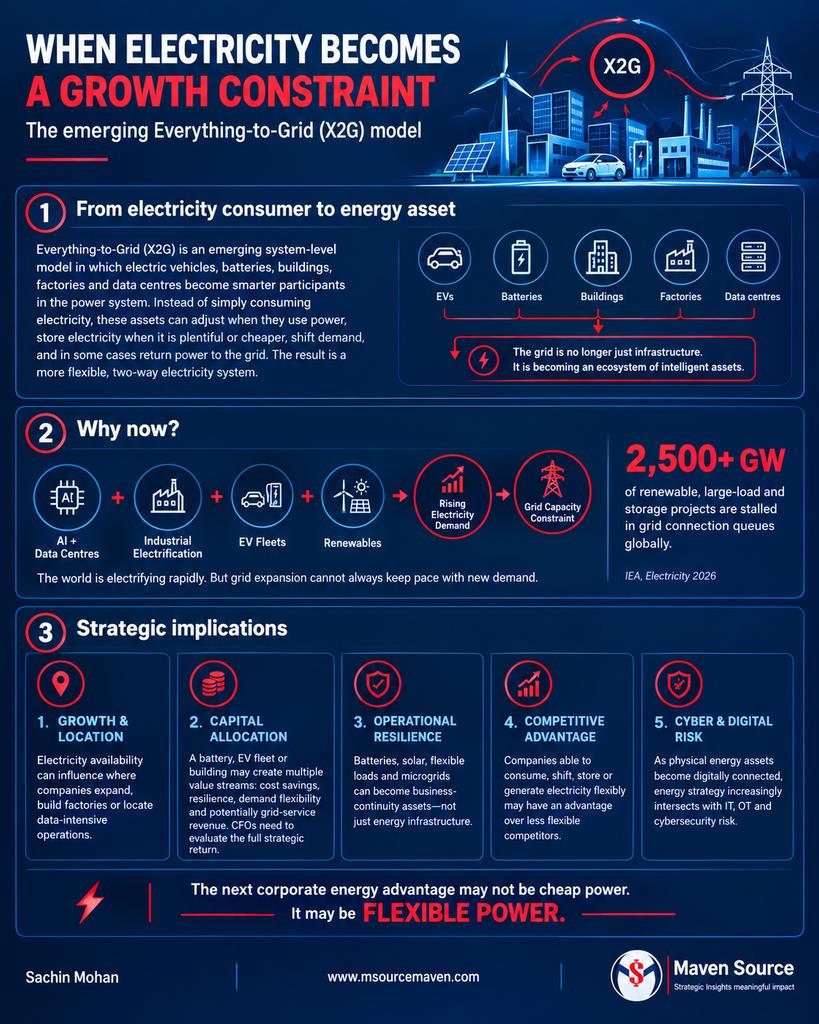
The economics of electricity is changing. The emerging trend is “Everything to grid “X2G”. Everything-to-Grid (X2G) is a simple idea: instead of treating electricity users such as electric cars, batteries, buildings, factories and data centres as passive consumers, we make them smart enough to adjust when they use electricity, store it when it is cheap or plentiful, and in some cases send electricity back to the grid when it is needed. In other words, the grid becomes a two-way, intelligent system where millions of everyday assets can help balance electricity supply and demand. Now the world is electrifying rapidly. Data centres are expanding because of AI, factories are electrifying their processes. Companies are shifting vehicle fleets from fuel to electricity. However the constrain is that the grid cannot always expand at the same speed.
The International Energy Agency says more than 2,500 GW of renewable, storage and large-load projects are currently waiting for grid connections globally. At the same time, grid investment needs to rise significantly this decade. The companies are starting to feel the consequences. Reuters reports that Pamela MacDougall, AWS’s Head of Energy Markets and Regulation for EMEA, said:“the timeline for getting a grid connection had become one of the biggest deciding factors in the company’s data center investments.” This is where a concept called Everything-to-Grid, or X2G, becomes interesting.In simple terms, X2G means treating electric cars, batteries, buildings, factories and even data centres not simply as electricity consumers, but as flexible energy resources.
Why does it matter?
For a strategist, important question is: What happens to corporate strategy when access to electricity becomes a constraint on growth? Imagine two companies planning identical factories. Company A needs a large, constant supply of electricity and has little ability to change its consumption. Company B has solar, batteries, flexible production schedules and intelligent energy management. It can move some electricity consumption away from peak periods and potentially participate in demand-response or other grid programmes. They may have similar factories. But they don’t have the same energy flexibility.
Google provides an interesting example. In 2026, Google announced that it had integrated around 1 GW of data-centre demand-response capacity into long-term contracts with US utilities. Some machine-learning workloads can be shifted or reduced when the grid is under stress. Microsoft has also been working with grid-interactive batteries and UPS systems at data centres, allowing energy infrastructure that traditionally existed mainly for backup power to potentially provide grid services. Amazon has been combining renewable generation with battery storage, including systems designed to optimise when batteries charge and discharge. Electricity is no longer only a cost.It is becoming a question of capacity, timing, resilience, optionality and potentially value creation.
Strategic implications:
The first implication is growth strategy. A company may have the capital, land, customers and technology to build a new facility but still struggle to secure sufficient electricity. That means electricity availability can increasingly influence location strategy. The future question may become: Where can we build and secure reliable electricity at the right cost and within the required timeframe?
The second implication is capital allocation. X2G changes not only how companies use assets, but also how they should evaluate investments in those assets. Take a battery for example, traditionally the investment case might be based on backup power and reducing peak electricity costs. But if that battery can also participate in demand-response or other grid-services markets, management has to consider additional potential value streams. The same asset could therefore have several economic purposes. The same logic applies to EV fleets and buildings. An EV fleet is primarily a transportation investment, but smart charging could potentially reduce electricity costs or create flexibility value. A building is primarily a property investment, but its HVAC systems, batteries, solar generation and EV chargers could make it a more flexible energy asset.
The third implication is operational resilience. Most companies think about resilience in terms of supply chains, cybersecurity, geopolitical risk and business continuity. Energy flexibility should increasingly sit alongside them. A company that can reduce demand, store electricity or generate some of its own power may have more options during grid disruptions or periods of extreme electricity demand.
The fourth implication is competitive strategy. This is where I think the issue becomes particularly interesting for strategists. If electricity becomes constrained, companies with flexible energy systems may have more strategic options. Strategy is often about having more options when uncertainty increases.
The fifth implication is cyber risk. The more batteries, EV chargers, buildings, factories and data centres become digitally connected to the electricity system, the more the energy system becomes dependent on software, communications and cybersecurity. The company may therefore move from managing an electricity risk to managing an interconnected energy + technology + cyber risk.
Questions every board should ask
Can we secure enough electricity for our growth plans over the next five to ten years? Not just today. What happens if our electricity requirement doubles?
How flexible is our electricity demand? Which parts of our operations can be shifted, reduced or rescheduled without affecting customers or production?
Which assets do we already own that could become energy resources? Our buildings, batteries, EV fleets, solar installations, cooling systems, manufacturing equipment and data-centre infrastructure may have more strategic value than we currently assign to them.
Are we investing in flexibility before we actually need it? Waiting until electricity becomes scarce may be considerably more expensive than building optionality gradually.
What happens if our energy infrastructure becomes digitally interconnected? Who owns that risk? The CFO? COO? CIO? CISO? all of them?
Actions leaders should consider in the next 12–24 months
Start with an energy flexibility map. Don’t just measure how much electricity the company consumes. Map when it consumes electricity and identify which loads can be shifted, reduced or stored. Then look at the assets you already have. Think if this asset consume, reduce, shift, store or generate electricity more intelligently? The next step is to include energy flexibility in major capital decisions. When evaluating a new factory, warehouse, office, data centre or fleet, don’t ask only about purchase price and operating cost, ask also about electricity availability, connection timelines, peak demand, storage potential and flexibility. Energy strategy should increasingly become a cross-functional boardroom conversation.