

A few percentage drop in oil prices following the temporary pause in U.S.-Iran hostilities may have reassured financial markets but I believe the bigger strategic risk remains unchanged. In fact within days, oil prices rebounded sharply after renewed missile attacks, lower U.S. crude inventories and a temporary refinery disruption in Saudi Arabia- now again there is a slight drop in crude oil prices. That sequence of events perfectly illustrates the point. Markets celebrated diplomacy one day and reacted to fresh geopolitical risks the next. For me, the lesson isn’t whether oil prices rise or fall this week. The lesson is how quickly the operating environment can change.
Over the past few months, I have been closely following developments in the Middle East. One pattern stands out. Financial markets react to today’s headlines, but businesses live with tomorrow’s consequences. A ceasefire can reduce oil prices overnight. A single missile strike can push them back up just as quickly. This tells me that the real challenge for businesses is no longer the absolute price of oil—it is the unpredictability of the global energy system itself.
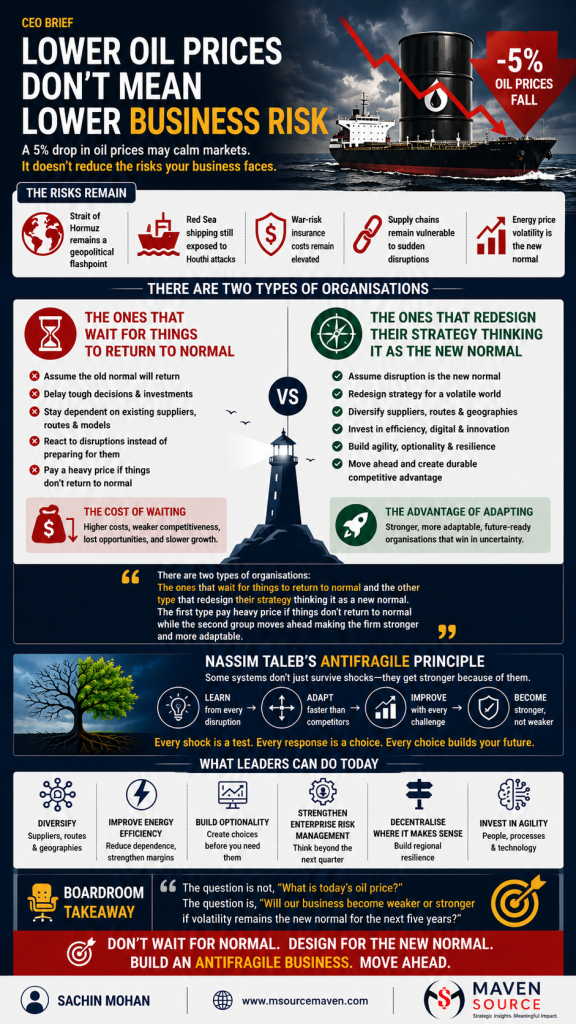
Why this matters? I believe the era of stable and predictable energy markets is fading. What businesses should prepare for is not permanently high oil prices, but permanently higher volatility in energy markets. Wars, sanctions, shipping disruptions, cyber threats and geopolitical tensions are increasingly driving energy prices, often more than traditional supply-and-demand fundamentals. Even if crude prices soften temporarily, freight costs, war-risk insurance premiums and supply-chain disruptions can continue to keep operating costs high.
Strategic implications: From my experience, organisations generally respond to disruption in one of two ways. The first group treats every crisis as temporary. Their strategy is built on the assumption that markets will eventually return to normal. They postpone difficult decisions, delay investments and wait for stability to come back. That approach works only if the old normal actually returns. If it doesn’t, these organisations often pay a heavy price through rising costs, weaker competitiveness and missed opportunities.
The second group assumes that disruption itself is the new normal. Instead of waiting, they redesign their strategy. They diversify suppliers, strengthen regional supply chains, improve energy efficiency, invest in digital capabilities and build greater organisational agility. Rather than asking, “When will things return to normal?”, they ask, “How do we succeed if this becomes the new normal?”
This distinction reminds me of Nassim Nicholas Taleb’s concept of Antifragile. Taleb argues that some systems do not merely survive shocks—they become stronger because of them. I believe the same principle applies to businesses. An antifragile organisation learns from every disruption. Each supply-chain shock encourages greater diversification. Every energy crisis accelerates efficiency improvements. Every geopolitical event strengthens its risk management and decision-making. Rather than resisting uncertainty, it uses uncertainty to improve. It becomes more adaptable after every challenge instead of becoming more fragile. In my experience, the companies that consistently outperform are not always the most efficient. They are the ones that adapt the fastest when assumptions change.
CEO takeaway: The question I would ask in every board meeting is no longer, “What is today’s oil price?” Instead, “If energy markets remain volatile for the next five years, will our business become weaker—or stronger?” Markets celebrate temporary peace. Leaders should prepare for structural uncertainty. The businesses that will lead the next decade will not be those waiting for stability to return. They will be the ones that redesign their strategies for a world where volatility is expected rather than exceptional. They will build diversified supply chains, invest in operational flexibility, strengthen decision-making and embrace adaptability as a competitive advantage.
Actions leaders should consider next
Reduce Dependence on Long, Fuel-Intensive Supply Chains: The era of optimising solely for the lowest production cost is ending. Long and complex supply chains are increasingly exposed to fuel price volatility, shipping disruptions and geopolitical risks. Building shorter, regional and more resilient supply networks can reduce both costs and uncertainty over the long term.
Reduce Dependence on a Single Supplier or Geography: Supplier concentration creates hidden strategic risk. A disruption in one country, one supplier or one shipping route can halt production overnight. Diversifying suppliers and sourcing locations builds optionality and ensures business continuity when unexpected events occur.
Redesign Strategy for Volatility: Many organisations still plan for a stable future. Leaders should instead assume that volatility is a permanent feature of the business environment. Strategies should be built to perform across multiple scenarios, not just under ideal conditions.
Build Flexibility into Contracts: Rigid contracts become liabilities when costs fluctuate rapidly. Businesses should negotiate contracts that allow adjustments for changes in fuel costs, freight rates and supply disruptions. Flexibility protects margins and strengthens long-term partnerships.
Invest in Operational Agility: Competitive advantage will increasingly belong to organisations that can respond quickly to change. The ability to switch suppliers, adjust production schedules, reconfigure logistics and respond to market shifts is becoming as important as operational efficiency.
Business leaders cannot control geopolitical events, shipping disruptions or oil prices. They can control how prepared their organisations are when those events occur.