
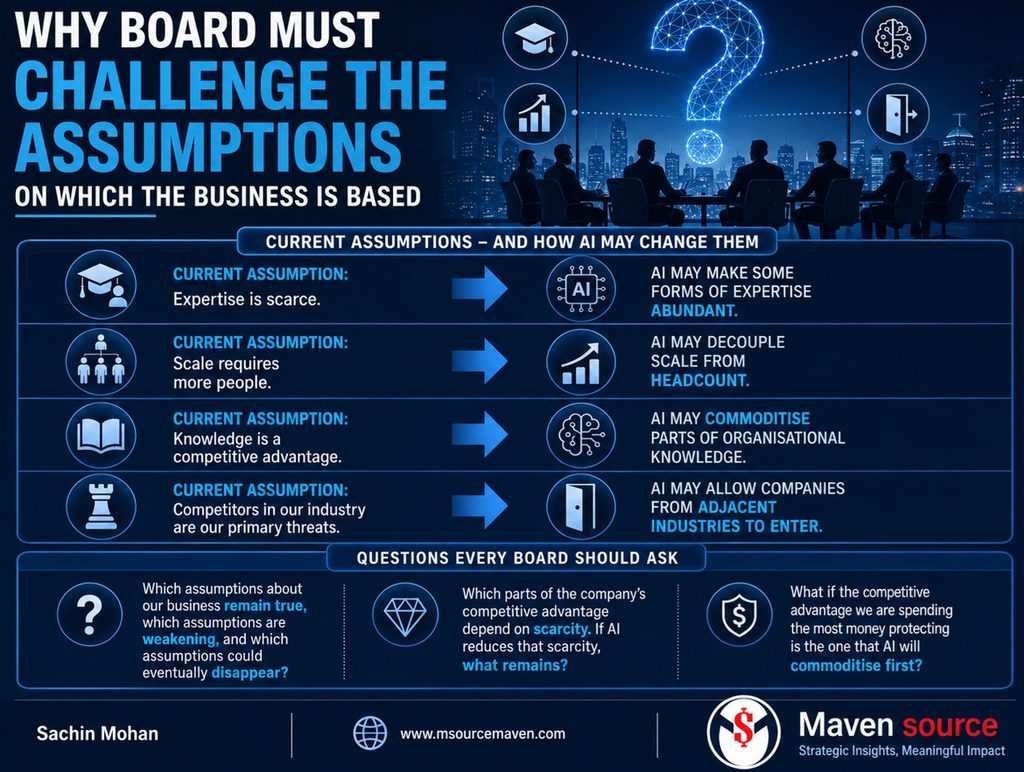
I can remember, around eight or nine years ago, when we were trying to automate knowledge work within organizations. At that time, the number of people involved in knowledge work was significantly higher than it is today. We conducted an exercise to track and map every step in the process of generating intelligence for the firm—an exercise similar to value stream mapping. People contributed to the discussion, but hardly anyone was convinced that mimicking knowledge work by a machine is possible. People who were working in domains of research, intelligence, accountancy, etc were confident that machines can’t replace them or at least can’t harm them severely. The success of a business unit was equivalent to increase in headcount! We all know AI changed the game. Not only knowledge work but also several work that needs human intelligence is partly or completely being replaced by machines. From automating repetitive work to creating ideas, AI is playing important roles. This brought us a very interesting question for the board and for the strategists: “Which assumptions about my business stop being true if AI becomes extremely capable?”
What happened?
For a very long time knowledge was deeply connected to organization capabilities. Several research and literatures highlighted the importance of knowledge and organizational capabilities. Teece, Pisano and Shuen, (1997); placed knowledge assets and organisational processes at the centre of the dynamic capabilities framework, while Zollo and Winter (2002) highlighted knowledge articulation, codification and experiential learning in the evolution of dynamic capabilities. Kogut and Zander (1992) similarly emphasised the firm’s ability to combine and transfer knowledge as an important organisational capability. But now, because of AI- this knowledge is abundant and all the organization has an access to it. Something that was scarce and limited to organizations’ walls becomes abundant! The question then becomes much bigger: what happens to a strategy when something that was previously scarce becomes abundant, cheap and increasingly accessible?
The strategic implications:
This is going to change the way we think about competition. The competition will emerge from anywhere as AI has lowered the barrier. This is not the world anymore where banks compete with banks, insurers with insurers, manufacturers with manufacturers and consulting firms with consulting firms. If AI lowers the cost of acquiring capabilities, those boundaries will come down. Now the board question is no more who is our competition? But who can acquire knowledge of our critical process to become our competitor? I see the biggest threat will be from companies whose close adjacency is core business of soe other company. Forward integration and backward integration would become easier. For example, steel manufacturers can move easily to advance filtration business, technology company can enter financial services. A retailer can develop sophisticated financial products.
Questions every board should ask
- Which assumptions about our business remain true, which assumptions are weakening, and which assumptions could eventually disappear?
- Which parts of the company’s competitive advantage depend on scarcity. If AI reduces that scarcity, what remains?
- What if the competitive advantage we are spending the most money protecting is the one that AI will commoditise first?
Actions leaders should consider
- Visit the assumption inventory: Identify the assumptions that you are basing your strategy. The objective is to identify the assumptions that may not be so strong now.
- Assumption stress test: Thinking of scenarios when AI becomes 5 times more capable and more cheaper. How will the business survive and thrive in that scenarios? What if there is a drastic change in demand?
AI may not just change how we execute strategy. It may change the assumptions from which we create strategy.